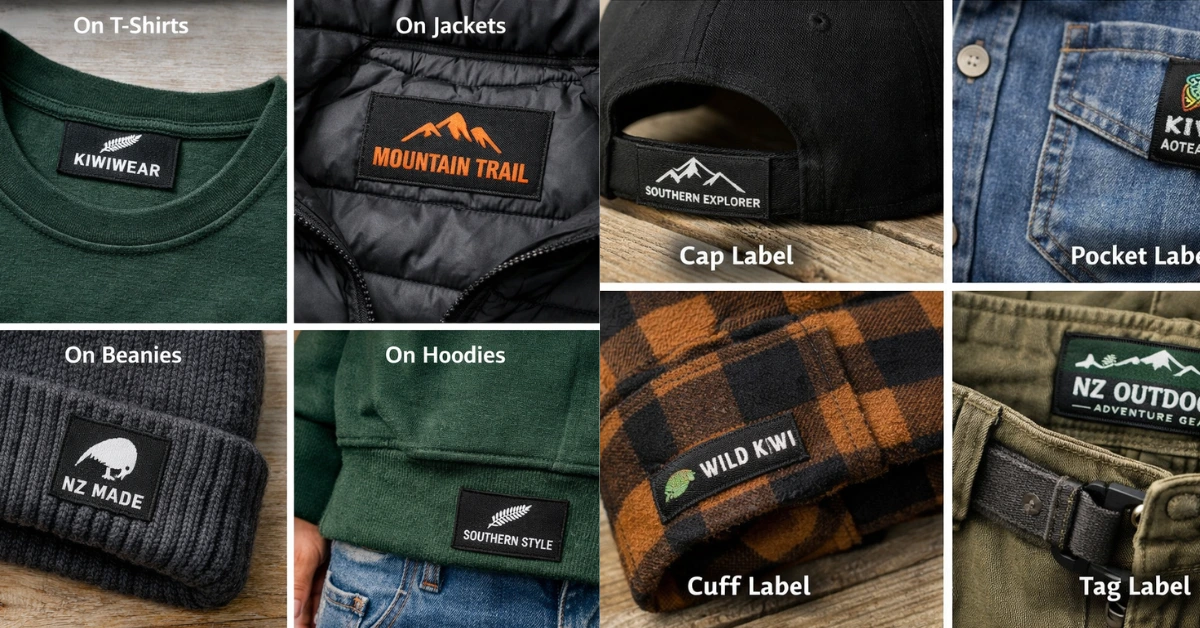
When choosing woven labels, the first step is to determine the type or style based on the garment’s placement. Choosing a label type—Straight Cut, Endfold, or Centrefold—based on visibility and needs is key. In this blog, we will define these 5 most used styles in the woven industry. Let’s begin,
1. Straight Cut
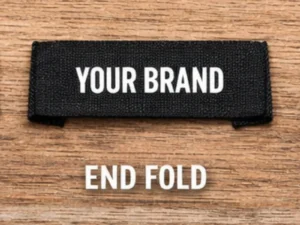 The straight cut remains the most traditional and widely used style for woven labels in the garment industry. You’ll recognize these labels by their clean, rectangular edges that are cut directly along the woven fabric’s border. They’re typically folded and sewn into garments at the neck, side seam, or waistband.
When designing your logo for straight cut labels, you’ll need to account for the fold line and seam allowance. Position your most important branding elements in the visible area, avoiding the stitched edges. This style offers you the most design flexibility and cost-effectiveness compared to other cuts.
You’ll find straight-cut labels ideal for minimalist designs, wordmarks, and logos that benefit from a traditional, no-frills presentation. They’re particularly popular in mass-market clothing production.
2. Endfold
Unlike straight-cut labels that require folding during garment assembly, endfold labels arrive pre-folded from the manufacturer with your design split across both visible sides. This configuration creates a professional loop that’s sewn directly into seams, typically at the neckline or side seam.
When designing for endfold labels, you’ll split your logo or text across two panels. Consider how the fold line divides your design elements.
| Feature | Specification |
|---|---|
| Fold Type | Center-folded vertically |
| Visible Sides | Both panels show design |
| Attachment | Sewn through fold |
| Design Layout | Split or mirrored imagery |
The fold itself becomes hidden within the garment’s seam, leaving both label faces exposed. You’ll need to account for this split when positioning text and graphics to guarantee balanced visibility.
3. Centrefold
 Similar to endfold labels, centrefold labels arrive pre-folded from your manufacturer, but they’re designed to hide one panel completely inside the garment. You’ll sew these labels along the fold line, leaving one side visible while tucking the other inside. This creates a cleaner aesthetic on the garment’s exterior.
Centrefold labels work exceptionally well for necklines and side seams where you want minimal visual interruption. They’re particularly effective when your logo needs to be prominently displayed on one side while care instructions remain hidden on the reverse. The folded design also adds durability, as the double-layer construction withstands repeated washing better than single-ply alternatives.
When designing your logo for centrefold labels, make certain critical branding elements appear on the outward-facing panel. Reserve the hidden side for regulatory information and washing instructions.
4. Miter Fold
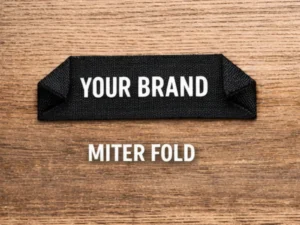 Miter fold labels feature diagonal corner folds that create a distinctive triangular appearance when sewn into your garments. These labels work exceptionally well for side seams and hems, offering a clean, professional finish that’s less bulky than traditional folds.
When designing for miter fold labels, consider these key factors:
-
- Corner space optimization – Position your logo centrally since the diagonal folds will create triangular corners that remain visible on the garment exterior
- Text orientation – Keep essential brand information away from fold lines to guarantee complete readability after installation
- Size considerations – Account for the folded edges in your design dimensions, as the visible label area will be smaller than the actual woven piece
This fold style enhances durability while maintaining sophisticated aesthetics.
5. Manhattan Fold
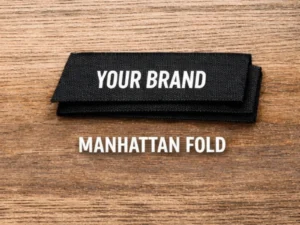 When you fold all four edges inward to meet at the label’s center, you create a Manhattan fold—one of the most refined finishing techniques for woven labels. This method completely conceals raw edges, delivering a premium appearance that’s ideal for luxury garments and high-end branding applications.
You’ll find Manhattan folds particularly effective when you’re designing labels that’ll be sewn onto visible garment areas. The symmetrical construction creates a clean, professional aesthetic from every angle. Since all edges tuck inward, there’s no risk of fraying or unraveling over time.
Consider using this fold when your logo requires maximum durability and visual appeal. The four-way fold increases label thickness, so you’ll want to ensure your fabric weight accommodates this structure without creating bulk.